
0 views
Download the full article: Read the article
When Documents Speak, Nature Cries Out
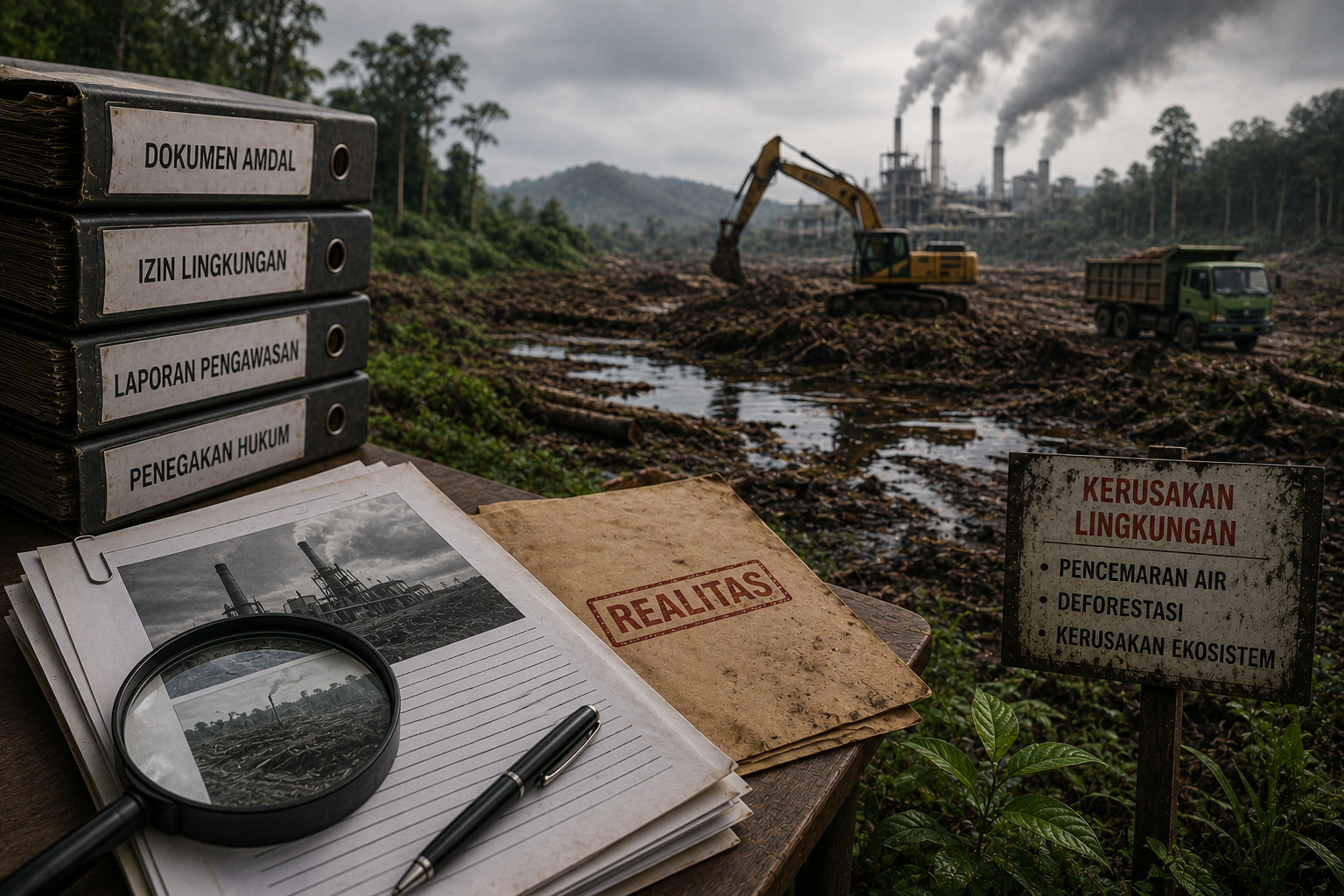
Sanggau Regency, West Kalimantan, stands at a critical crossroads. Its natural wealth has made it a favoured investment destination since Kalimantan’s first wave of oil palm, rubber and acacia plantations in the 1980s. Yet the ecological impacts are now unmistakable: floods, haze, extreme heat and drying rivers are the consequences of uncontrolled extraction. The widely publicised PT SBW case, involving alleged pollution of the Lape River, is the tip of a much larger iceberg. Ironically, PT SBW had already received administrative sanctions after discrepancies were found between its Environmental Impact Assessment (AMDAL) and conditions on the ground. This is more than a procedural breach: it betrays the basic principles of environmental protection.
The Gap between Rules and Practice: AMDAL as a Dead Letter Alive Only on Paper
Law No. 32 of 2009 on Environmental Protection and Management (UU PPLH) clearly requires every business to have an Environmental Impact Assessment (AMDAL) as the basis for its environmental permit. When implementation differs from the assessment, as in the PT SBW case, administrative sanctions should open the way to stronger penalties. Reality is different. Findings that 18 mining companies in South Kalimantan were allowed to operate without meeting AMDAL requirements show the same pattern: weak oversight, poor inter-agency coordination and permits still issued despite unmet environmental conditions. This is not merely a technical problem, but a systemic failure of environmental law enforcement.
Negligence Is No Excuse: Criminal Provisions without Teeth
Article 99(1) of UU PPLH provides for at least 1 year’s imprisonment and fines of up to Rp3 billion for pollution caused by negligence. Intentional offences carry heavier penalties: 3–10 years’ imprisonment and fines of Rp3–10 billion. Negligence is therefore itself a punishable offence. Fires in Sanggau’s industrial timber concessions, acted upon only after they occurred and caused severe haze, exemplify negligence that should attract criminal liability. Industrial timber companies that fail to prevent fires breach environmental-management obligations set out in their permits and AMDAL documents.
The Polluter-Pays Principle
UU PPLH adopts the polluter-pays principle, requiring companies to restore damaged environments. In the deforestation case involving PT CUT, which was merely “asked to replant”, the gap between principle and enforcement is clear. Light administrative sanctions, without additional criminal measures requiring measurable environmental restoration, demonstrate that the state remains lenient towards environmental offenders.
The History of Agrarian Conflict: Unresolved Roots
Forest-management conflict in Indonesia is not new. Since the colonial era, centralised forestry policies have disregarded local community rights. The nineteenth-century scientific-forestry paradigm, treating forests as “uninhabited areas” and people as a “threat”, persists in Forestry Laws No. 5 of 1967 and No. 41 of 1999. The state has brought forests under state control, claiming them as state property and excluding Indigenous rights. The 1960 Basic Agrarian Law (UUPA), intended as the overarching framework for managing agrarian resources, was sidelined. Overlapping sectoral laws emerged, opening the way to massive natural-resource extraction.
This legacy is evident in Sanggau. Plantation and mining companies operate on land managed by communities for generations, while Indigenous rights over forests and rivers remain neglected. The customary sanctions upheld by Binjai Village residents, who seek a resolution to the PT SBW case grounded in local wisdom, resist the dominance of state law that so often favours corporations.
Oversight: Fragmented Powers, Narrowed Accountability
Fragmented authority is a major weakness in environmental enforcement. The regency Environment Office conducts verification and routine oversight, but the Energy and Mineral Resources Ministry holds technical mining-supervision powers. Inter-agency coordination frequently falls short, leaving many violations undetected.
Worse still, gold mines licensed to operate on land but extracting resources in the Kapuas watershed, or bauxite mines filling peat swamps in Toba District, show how companies frequently manipulate permits and environmental documents. Administrative penalties without criminal sanctions become merely an “operating cost” for corporations that disregard the rules.
The Fiscal Dilemma: Regional Dependence on Central Government and Investment
Transfers to Regions (TKD) account for 53.4% of West Kalimantan’s revenues, creating a difficult dependency. A Rp522 billion cut forces local governments to concentrate on basic services at the expense of environmental oversight and enforcement. Entikong District offers another irony: the movement of people and goods through the border generated Rp95 billion in 2025, yet nearby villages still lack electricity, roads are damaged and many schools are in disrepair. What returns to the region is not proportionate to its contribution to state coffers.
Fear of “losing investment” is often used to justify weak enforcement. Yet unsustainable investment harms the region: local revenues do not rise significantly, while environmental-recovery costs will be far greater. The real investors are the communities themselves, who have managed resources sustainably.
Worse still, gold mines licensed to operate on land but extracting resources in the Kapuas watershed, or bauxite mines filling peat swamps in Toba District, show how companies frequently manipulate permits and environmental documents. Administrative penalties without criminal sanctions become merely an “operating cost” for corporations that disregard the rules.
Recommendations: Towards Just Environmental Governance
Worse still, gold mines licensed to operate on land but extracting resources in the Kapuas watershed, or bauxite mines filling peat swamps in Toba District, show how companies frequently manipulate permits and environmental documents. Administrative penalties without criminal sanctions become merely an “operating cost” for corporations that disregard the rules.
Stronger Criminal Sanctions and Environmental Restoration
Administrative sanctions must be a gateway to criminal penalties, not a substitute. Companies proven to have breached AMDAL requirements and damaged the environment must face criminal prosecution, with additional environmental-restoration measures under Article 119 of UU PPLH. Judges should apply Supreme Court Regulation No. 1 of 2023 on Guidelines for Adjudicating Environmental Cases, which requires restoration based on a recovery plan.
Independent Oversight and Public Participation
Oversight cannot rely on government officials alone. Civil society, universities and the media must become monitoring partners. Village officials who documented and publicised the PT SBW case demonstrate that communities can provide effective oversight.
Regulatory Harmonisation and Resolution of Agrarian Conflicts
The 1960 Basic Agrarian Law must be revitalised as the overarching framework for fair management of agrarian resources. Conflicts must be resolved by recognising Indigenous rights, not through repression. Customary sanctions, as proposed by Binjai Village residents, should be accommodated in resolving environmental cases.
Strengthening Community Capacity
The real investors are the people themselves, who have centuries of experience managing natural resources sustainably. Government, civil society and universities should strengthen their capacity, provide capital and build market networks.
Economic Self-Reliance
Local governments should activate regional enterprises linked directly to community production businesses, whether managed by government itself or its development partners. Existing producer cooperatives and village-owned enterprises (BUMDes) should also be strengthened through better management skills and institutional governance.
Closing: A Just, Sustainable and Prosperous Sanggau
Sanggau was Kalimantan’s first regency to host large oil palm, rubber and acacia plantations. That experience should become a lesson, not a burden. Its intelligent, determined young people are valuable assets capable of driving change.
It is time for the region, its political leaders, regional and national elected representatives and all stakeholders to speak out against the injustices communities experience. Protecting forested areas and the environment is not an obstacle to development. It is the foundation of sustainable life.
The Kapuas River, flowing for 1,143 kilometres, is West Kalimantan’s lifeline. When its waters are polluted, its air filled with smoke and its forests stripped bare, Sanggau is not alone in suffering: the whole province’s ecosystem is affected. Firm environmental oversight and law enforcement are not optional. They are essential to future generations’ survival.