
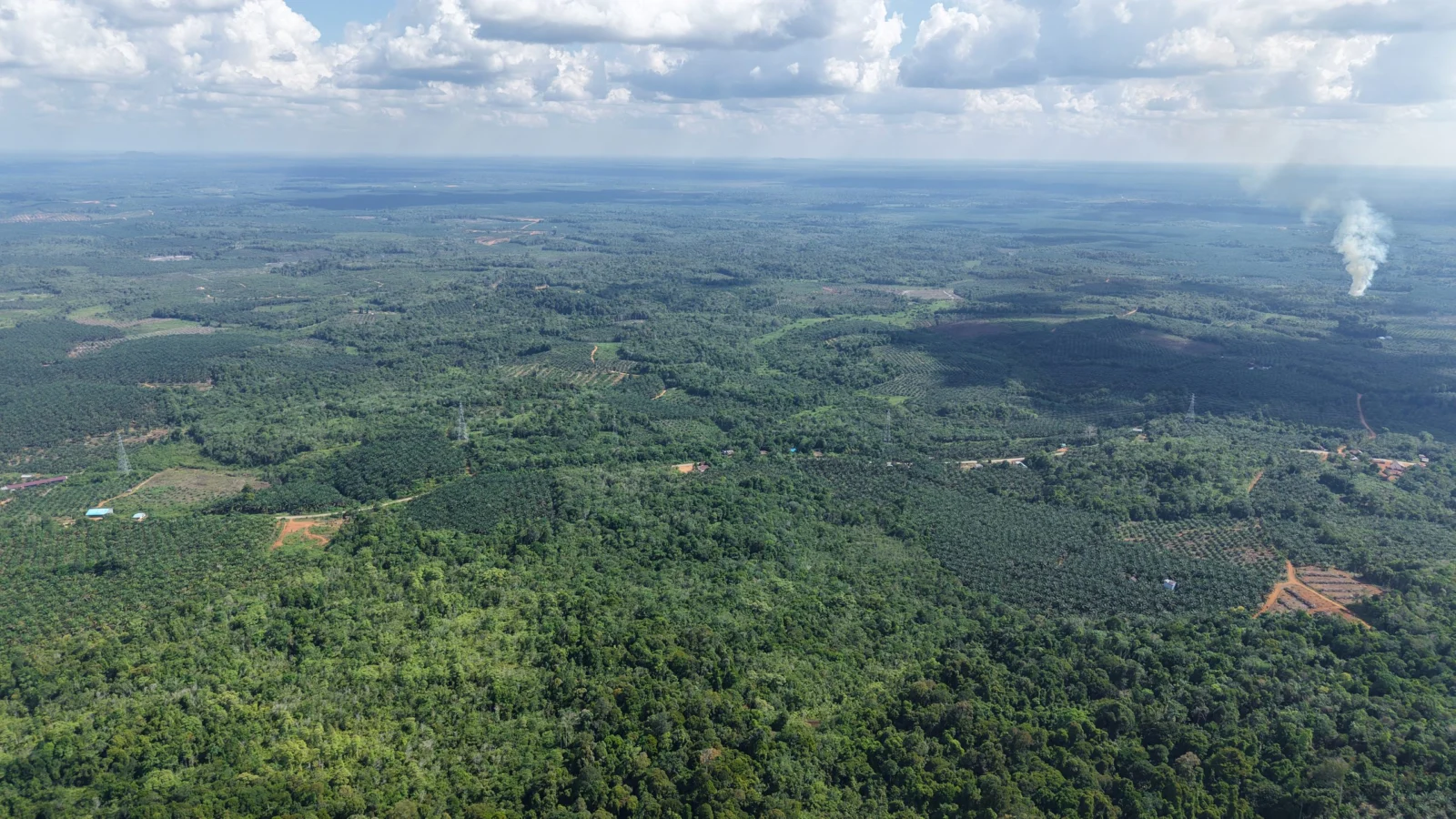
Debates over ESG, NDPE, the OECD Guidelines, and sustainable development commitments often stall at technical questions: whether a company has a policy in place, whether its reports have been audited, or whether it has obtained certification. Yet the more fundamental question is whether this entire architecture actually changes who controls the land, who captures the profits, and who bears the losses. In the Indonesian context, the answer is frequently disappointing.
Indigenous peoples, smallholder farmers, fishers, workers, and local residents routinely bear the costs in the form of land loss, pollution, fires, poverty, and criminalization, while economic gains remain concentrated among corporations, financiers, and a narrow circle of state beneficiaries. Sustainability commitments must therefore be judged not by the number of clauses, annual reports, or certification logos, but by whether they end impunity and remediate real harm.
A frequently distorted definition
Sustainable development does not mean “continuous economic growth so long as the environment is minimally protected.” The most widely cited definition, formulated by the Brundtland Commission and adopted across UN frameworks, states that sustainable development is development that meets the needs of the present without compromising the ability of future generations to meet their own needs. This definition rests on three core principles:
- Intergenerational justice: today’s generation must not deplete forests, water, soil, and peatlands to the point that future generations are deprived of the foundation for life.
- Social justice: economic benefits must not be secured by stripping vulnerable groups of their rights, livelihoods, and dignity.
- Ecological accountability: environmental destruction must be accounted for as a real cost, rather than dismissed as a negligible “side effect.”
By this standard, human rights abuses and environmental destruction cannot be called sustainable. What is truly sustainable is meeting economic needs without destroying communities’ foundations for life or offloading the costs of damage onto future generations. Conversely, when profits steadily climb while forests vanish, peatlands dry out, rivers are polluted, and communities lose their land, what is being sustained is not development, but a pattern of exploitation and cost-shifting.
Existing instruments
Several instruments are routinely invoked to substantiate sustainability claims. Each, however, carries distinct strengths and limitations.
| Instrument | Nature | Function | Key Weaknesses |
| NDPE (No Deforestation, No Peat, No Exploitation) | Supply chain policy, primarily in palm oil | Requires suppliers not to clear forests, not to develop peatlands, and not to engage in social exploitation (Indigenous peoples/local communities and workers). | Relies on traceability, independent audits, and meaningful sanctions |
| OECD Guidelines for Multinational Enterprises | Non-binding business conduct standards | Urges companies to conduct due diligence and address human rights and environmental impacts | Not a court of law; enforcement depends on National Contact Points and political pressure |
| UN Guiding Principles on Business and Human Rights | UN business and human rights framework | Affirms the state duty to protect citizens and the corporate responsibility to respect human rights | Not a directly binding legal instrument |
| ESG | Risk management and reporting framework | Measures environmental, social, and governance risks | Can devolve into cosmetic reporting when consequences are absent |
| Constitutional Court Decision No. 35/PUU-X/2012 | Indonesian Constitutional Court ruling | Affirms that customary forests are not state forests, but forests subject to rights | Implementation is often delayed, restricted by bureaucratic procedures, or in conflict with legacy permits |
The OECD Guidelines call on enterprises to carry out risk-based due diligence: identifying impacts, preventing and mitigating them, ceasing activities that cause harm, and providing remediation. The UN Guiding Principles similarly affirm that companies must prevent, mitigate, and remediate adverse human rights impacts they cause or are linked to through their operations. Yet the OECD Guidelines are not a court of law. They are supported by National Contact Points (NCPs), which facilitate dialogue and handle complaints, but lack the authority to imprison offenders or revoke permits directly. Accordingly, OECD commitments can serve as an important lever of pressure, but they are no substitute for state law enforcement.
ESG: tool or cosmetic cover?
ESG is frequently promoted as proof that corporations have reformed. At its core, however, ESG is a risk-management and reporting framework—not a guarantee of justice. A company can boast high ESG scores, thick sustainability reports, and international certifications while remaining implicated in deforestation, land conflicts, pollution, or labor exploitation. The primary danger of ESG arises when it turns into greenwashing or human-rights-washing:
- Companies trumpet “zero deforestation” commitments while withholding supplier data down to the plantation level.
- Companies claim “responsible sourcing” while continuing to buy from conflict-ridden areas.
- Companies publish ESG reports without terminating contracts with suppliers proven to have committed violations.
- Companies label local communities “partners” even when residents lack the power to reject a project.
- Companies fund CSR programs without remediating the environmental or social harm already inflicted.
Environmental claims must not go unsubstantiated either. Under European Union frameworks, explicit environmental claims must undergo substantiation assessments backed by robust, verifiable evidence. This principle is vital: without independent verification, “sustainability” claims are reduced to mere marketing tools.
Do buyers know or not?
A critical question is whether global buyers are genuinely unaware of conditions on the ground. The answer is that they have the capacity to know, yet often choose not to look closely enough. Major buyers possess the capability to map supply chains down to the mill, plantation, or production area, and to deploy satellite data and deforestation monitoring.
- Conducting unannounced independent audits.
- Interviewing workers, Indigenous peoples, and affected residents.
- Establishing safe grievance mechanisms.
- Suspending purchases from suppliers proven to have committed violations.
Nevertheless, many buyers opt for the cheaper path: relying on supplier self-declarations, periodic scheduled audits, or certifications that are easy to pass. Consequently, ignorance is often not a technical limitation, but an unwillingness to know—what human rights discourse terms willful blindness. The OECD underscores that merely adopting a policy is insufficient; enterprises must identify, prevent, cease, and remediate both actual and potential impacts. If buyers demand nothing more than a “letter of non-violation,” they fall well short of due diligence standards.
Indonesia: an extractive economy and social vulnerability
Indonesia’s economic foundation remains heavily dependent on natural resources. The OECD notes that the Indonesian economy continues to rely on international demand for raw materials and unprocessed commodities, particularly from China. The World Bank has likewise observed that Indonesia’s growth has been driven by carbon-intensive commodities and unsustainable natural resource exploitation. This dynamic creates powerful structural incentives:
- The state seeks investment, tax revenues, royalties, and foreign exchange.
- Corporations seek land, energy, water, and cheap supply chains.
- Local communities often hold weak bargaining power.
- Human rights and environmental protections risk being treated as costs to be minimized.
It is important, however, not to oversimplify the problem into an accusation that “all government officials and all corporations are colluding.” A more accurate assessment is that prevailing incentive structures and power relations consistently subordinate citizen protections to investment interests.
Forest and land fires: a symptom of structure, not just behavior
Forest and land fires are routinely framed as a behavioral problem caused by smallholder farmers clearing land with fire. While partially true, this narrative is deeply incomplete. Deforestation and peatland drainage have transformed landscapes into tinderboxes, making fires far more widespread, deeper-burning, and harder to extinguish. Research on Central Kalimantan’s peatlands demonstrates that canals dug for timber extraction and large-scale drainage for plantations created the structural conditions that rendered the landscape highly flammable. Blaming smallholders without dismantling drainage systems, concession permits, and supply chain drivers turns farmers into scapegoats for destruction that is largely structurally engineered.
Overlapping permits: the root of conflict
One of the primary drivers of agrarian and environmental conflict is overlapping permits. Research has identified 1,411 areas of overlap between mining business permits and palm oil cultivation rights (HGU), spanning roughly 448,632 hectares, predominantly across Sumatra and Kalimantan. Mining permits also overlap with 5.2 million hectares of designated forest areas. Human Rights Watch has documented how the government has granted land concessions overlapping with transmigration lands; when companies fail to consult residents, provide compensation, or conduct impact assessments, conflict ensues. This is no mere technical oversight, but the outcome of a system that prioritizes permitting while treating citizens’ rights as a matter that can be indefinitely deferred.
Constitutional Court Decision 35: rights deferred
Constitutional Court Decision No. 35/PUU-X/2012 affirmed that customary forests are no longer part of state forests, but are instead forests subject to rights. The state may not treat customary forests as empty lands awaiting bureaucratic allocation or licensing. Yet implementation has repeatedly stalled. Indigenous peoples are frequently forced through protracted hurdles—mapping, verification, regional regulations (Perda), and ministerial decrees—even though customary tenure rights should not have to be “won back” through exhausting bureaucratic processes. AMAN has warned that social forestry schemes such as Village Forests, Community Forests, Partnership Forests, and Community Plantation Forests imposed over customary territories risk obscuring customary rights because they remain anchored in state permits and state-controlled management. While the government claims roughly 400,000 hectares of customary forest have been recognized, that figure does not answer criticisms that recognition comes far too late and places an undue burden on communities.
The Tae case in Sanggau: overlap on the ground
The Ketemenggungan Tae Customary Forest was formally designated through Minister of Environment and Forestry Decree No. 5770/MENLHK-PSKL/PKTHA-PSL-1/9/2018 on September 7, 2018, covering 2,189 hectares. While the community was conducting participatory mapping, a company carried out surveys in the village and, according to reports, already held a Plantation Business Permit (IUP). Residents rejected the company’s presence. This demonstrates that the problem is not merely “new permits issued after a decree,” but that the state allows legacy permits to remain active over territories subsequently recognized as customary forests.
A similar pattern is evident in the Tombak Haminjon Customary Forest belonging to the Pandumaan-Sipituhuta Indigenous peoples, portions of which remain inside the concession of PT Toba Pulp Lestari. This pattern shows that formal recognition of customary forests does not automatically extinguish overlaps with previously issued state business permits.
Barriers to participation: why communities are disempowered
Communities are not weak out of apathy. They are systematically disempowered by structures that keep information out of reach, make speaking up unsafe, leave land tenure unrecognized, and allow violations to go without remedy. Key structural dynamics include:
- The state seeks investment, tax revenues, royalties, and foreign exchange.
- Corporations seek land, energy, water, and cheap supply chains.
- Local communities often hold weak bargaining power.
- Human rights and environmental protections risk being treated as costs to be minimized.
The core critique: power, not just policy
The fundamental critique is not that every clause and commitment is drafted with fraudulent intent, but that the system is designed and operated in a way that enables investment interests, state revenue, and corporate objectives to materialize far more readily than protections for citizens.
When violations result only in administrative sanctions, drawn-out mediation, or token compensation, perpetrators factor them in as a cost of doing business rather than a deterrent. That is why ESG and NDPE commitments so often ring hollow: they stop at reports and pledges, while the decisions that truly matter—granting permits, revoking permits, allocating land, resolving disputes, and delivering remediation—remain governed by power relations among the state, corporations, and capital.
Conclusion
The central takeaway from this analysis is that NDPE commitments, ESG frameworks, the OECD Guidelines, and other sustainability instruments can no longer be treated as automatic proof that corporations or states have changed. They only carry meaning when they alter three fundamental realities: who controls the land, who captures the profits, and who bears the losses.
NDPE: from commitment to consequence
NDPE (No Deforestation, No Peat, No Exploitation) is frequently hailed as the gold standard across palm oil and other commodity supply chains. Yet NDPE can only work if backed by:
- Full traceability down to the plantation and landholder level, not merely to the mill or trader.
- Independent audits that cannot be manipulated by suppliers.
- Real sanctions, including contract termination, suspension of purchases, and revocation of market access.
- Ecosystem restoration and compensation for affected communities.
Without these four pillars, NDPE risks remaining a paper declaration. The Tae case in Sanggau illustrates that recognizing customary forests does not automatically cancel pre-existing business permits, meaning NDPE cannot function while overlapping permits remain unresolved.
ESG: the risk of greenwashing
ESG is too often deployed as a marketing instrument rather than a vehicle for structural change. Its core dangers are greenwashing and human-rights-washing:
- Companies claim “zero deforestation” without ground-level verification.
- Companies secure high ESG ratings while remaining entangled in land conflicts.
- Companies publish sustainability reports while continuing to source from non-compliant suppliers.
- Companies call communities “partners” even when residents lack
the power to refuse a project.
Under European Union standards, explicit environmental claims must be substantiated by strong, verifiable evidence. Without independent verification, ESG serves as little more than public relations.
OECD Guidelines: pressure without teeth
The OECD Guidelines require companies to conduct risk-based due diligence: identifying, preventing, ceasing, and remediating adverse impacts. However, the OECD Guidelines are not a court of law. They rely on National Contact Points (NCPs), which facilitate dialogue but lack the power to imprison violators or revoke permits. Consequently, the OECD Guidelines are only effective when reinforced by:
- Robust domestic law enforcement.
- Market pressure from buyers and investors.
- Public scrutiny from civil society and the media.
- Tangible economic consequences for perpetrators.
A recurring pattern: permits move faster than rights
A recurring pattern across Indonesia unfolds as follows:
- Permits are granted first based on the land’s administrative classification as state forest.
- Customary tenure rights are recognized later—often only after conflict erupts.
Overlaps go unresolved because Government Regulation (PP) No. 43/2021 prioritizes mediation over permit revocation. Communities are forced to negotiate from a position of weakness against corporations armed with capital, machinery, and access to security forces. Data shows 1,411 overlapping areas between mining permits and palm oil cultivation rights (HGU), covering roughly 448,632 hectares. This is no technical accident, but the product of a system that treats licensing as an immediate priority and citizens’ rights as
an issue that can wait.
The core critique: power, not just policy
The sharpest critique is this: not every clause and commitment is crafted to deceive, yet the system is structured and run so that investment interests, state revenues, and corporate priorities are realized far more easily than the protection of citizens.
When violations lead only to administrative penalties, protracted mediation, or minimal compensation, offenders treat them as a routine operating expense rather than a deterrent. This is why ESG and NDPE pledges so easily feel empty: they end at reports and public statements, while the decisive choices over permit issuance, permit revocation, land allocation, dispute resolution, and remediation remain firmly within the power nexus of the state, corporations, and capital.
Final conclusion
Thousands of regulatory clauses will mean nothing so long as the hierarchy of power remains inverted: state permits move faster than the recognition of rights, corporate profits enjoy stronger protection than citizens’ livelihoods, and abuses are more readily excused than remediated. Evidence of millions of hectares of overlapping permits, agrarian conflicts, and the criminalization of environmental defenders demonstrates that this is not merely a technical failure, but a crisis of governance and power.
The most urgent question is not “why are existing rules still insufficient?” Rather, it is: why does the system consistently deliver certainty for profit while offering only uncertainty for community rights? Until that question is answered, ESG, NDPE, and every sustainability pledge will continue to risk serving as a vocabulary that conceals injustice rather than a tool to end it.
References
OECD. OECD Guidelines for Multinational Enterprises on Responsible Business Conduct. 2023.
OHCHR. Guiding Principles on Business and Human Rights. United Nations. Sustainable Development Goals.
OECD. Economic Surveys: Indonesia 2024. World Bank. Indonesia and Environment.
Human Rights Watch. Grabbed Land, Silenced Justice. 2026.
Mongabay. Desa Tae yang Bergiat Setelah Terima Penetapan Hutan Adat. 2019.
AMAN. Satu Dekade Putusan MK 35.
Jurnal Sylva Lestari. Overlapping Permits and Land Conflict.
OECD. Accelerating Sustainable Infrastructure Investments: Indonesia. 2026
Download the full article via the following link >> This Link <<