
0 views
An Export Celebration amid the Haze
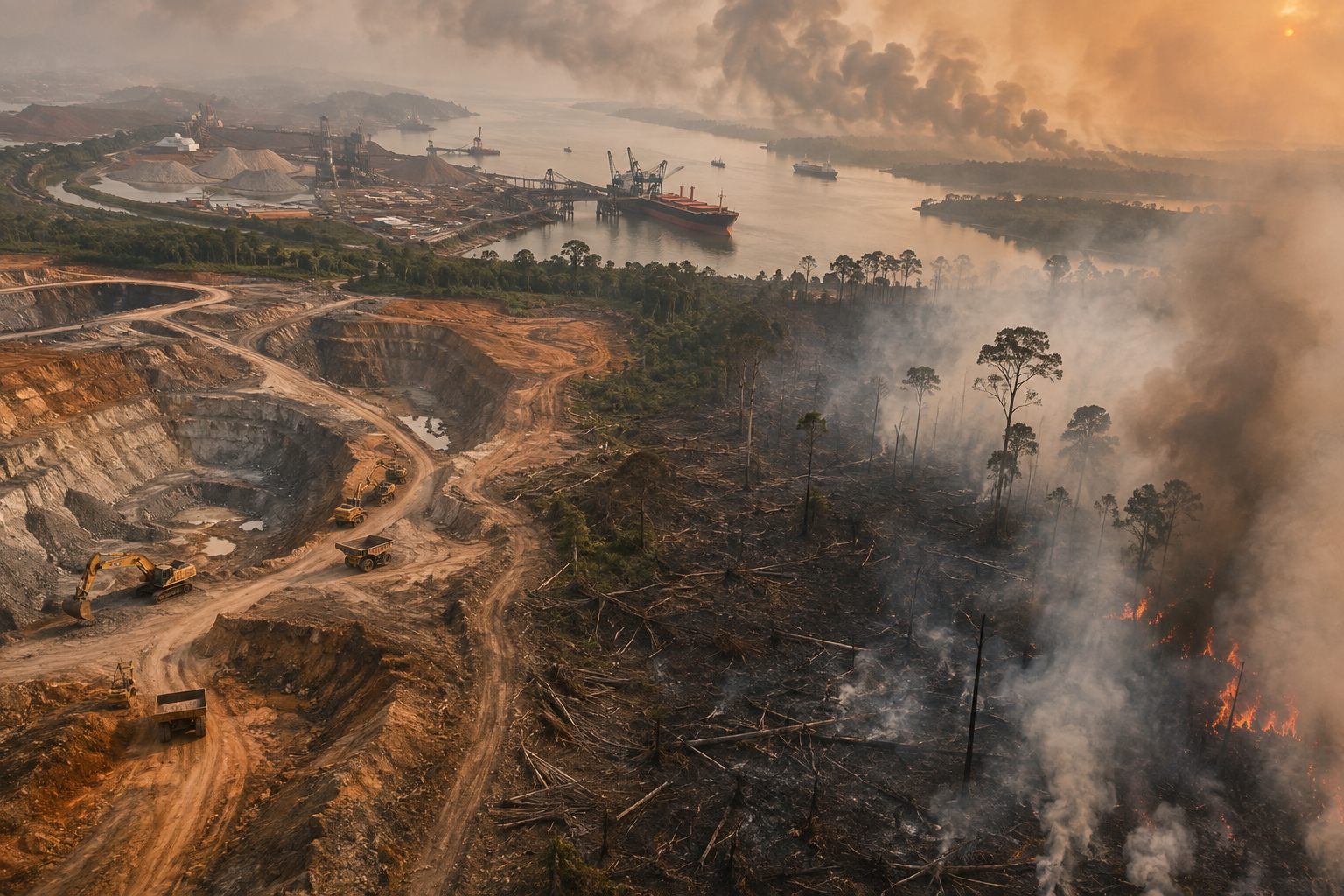
On 7 August 2026, Indonesia announced another achievement in downstream processing. In an official ceremony, 800 tonnes of alumina, produced from bauxite, were dispatched from Dwikora Port in Pontianak to South Korea and Japan. More than 100 ships previously held up by a regulatory dispute over rare earth elements (LTJ) finally sailed, carrying almost 400,000 tonnes of mineral commodities valued at US$124 million, or Rp2.2 trillion. At the same time, thick haze once again engulfed West Kalimantan. Thousands of residents in Mempawah and surrounding areas developed acute respiratory infections (ISPA). Schools closed, flights were disrupted and economic activity ground to a halt. These two realities—the export celebration and the haze disaster—unfolded together. This was no coincidence. They are two sides of the same coin: the inequitable, unsustainable exploitation of natural resources. This article examines, through an objective, scientific approach, the fiscal disparities confronting West Kalimantan, measurable ecological damage, the loss of forests’ carbon-absorption capacity as a major driver of more severe fires, and the laws and policies underlying the problem.
Economic and Fiscal Analysis: How Much Actually Returns to West Kalimantan?
The fundamental question is how much income the people and provincial government of West Kalimantan actually receive from the exploitation of their natural resources. West Kalimantan holds 66.77% of Indonesia’s bauxite reserves, approximately 3.29 billion tonnes. In theory, processing bauxite into alumina should increase added value and regional revenues. Conditions on the ground tell a different story.
According to calculations by West Kalimantan’s Regional House of Representatives (DPRD), natural resources extracted from the province generate tens of trillions of rupiah every year—an estimated Rp31 trillion across extractive sectors. Yet the amount returned through the revenue-sharing fund (DBH) is comparatively small.
Zulfydar Zaidar Mochtar, chair of the PAN faction in the provincial DPRD, stated: “By our calculation, out of Rp31 trillion, the funds we received in 2025 were around Rp230 billion. That is less than 1%.” In other words, for every Rp100 in natural-resource value generated in West Kalimantan, less than Rp1 returns through this scheme to support regional development, infrastructure maintenance or environmental restoration.
Deputy Governor Krisantus Kurniawan also spoke out: “West Kalimantan is a producing region. It is certainly unfair if the revenue-sharing funds it receives are not commensurate with the natural resources generated here.”
This imbalance is not merely administrative. It concerns the structure of fiscal relations between central and regional government and the centralised design of natural-resource policy, discussed further below.
Ecological Impacts: Damaged Forests, Peatlands and Rivers
Alongside fiscal losses, measurable ecological destruction imposes a heavy cost on West Kalimantan’s environment and communities.
a. Extensive Deforestation
Forest Watch Indonesia (FWI) reports that West Kalimantan lost approximately 1.5 million hectares of natural forest between 2000 and 2020. Conversion to bauxite mining, oil-palm plantations and industrial timber plantations (HTI) was the principal cause. Once-dense primary forests have become barren open-pit mines.
b. Peatland Degradation and Changes in Carbon Absorption
West Kalimantan has 2.8 million hectares of peatland, within which there are 123 mining business permits (IUP). Field findings by the Indonesian Forum for the Environment (Walhi) show that many companies have dug drainage canals through peatlands. This dries peat that should remain wet, turning it into a “time bomb” capable of triggering major fires during the dry season.
c. Water Pollution and Heavy Metals
Data from West Kalimantan’s Environment and Forestry Agency indicate significant increases in total suspended solids (TSS) and metals such as aluminium and iron in tributaries of the Kapuas River whose headwaters lie in mining areas. Mukhlis et al. (2020) confirmed that heavy-metal concentrations in waters around mines exceeded government quality standards. The Kapuas River—the lifeblood of surrounding communities—faces a gradual deterioration.
4. Carbon-Absorption Analysis: When Primary Forest Becomes a Mine
One particularly important scientific and educational issue is the loss of forests’ function as carbon sinks. How much carbon can forests absorb, and what happens when they are converted to mines?
a. Primary Forest Absorption Capacity
Biomass research in old secondary forest in Sintang, West Kalimantan, reports:
- Standing biomass: 306.54 tonnes per hectare (t/ha)
- Carbon content: 144.07 t C/ha
- CO₂ absorption capacity: 528.75 tonnes per hectare per year
National Geographic data and research in primary forest in Gunung Halimun-Salak National Park also report similar figures, with an emission factor for primary dryland forest of 222 tonnes of carbon per hectare. In other words, every hectare of intact forest can absorb around 500–530 tonnes of atmospheric CO₂ each year.
b. Post-Mining Land Capacity
What about former bauxite mines? Research at PT Cita Mineral Investindo Tbk., Sandai Site, Ketapang Regency, offers a striking comparison:
- Buffer zone (forest): potential CO₂ absorption of 204.13 t/ha.
- Revegetated post-mining land: potential CO₂ absorption of only 4.12 t/ha.
This means former bauxite-mining land loses almost 98% of its carbon-absorption capacity compared with surrounding forest. Of a potential 204 tonnes of CO₂ absorbed, only around 4 tonnes remain. This is more than a decline: it is a substantial loss of ecological function.
Applied to West Kalimantan’s 1.5 million hectares of deforestation, the total loss of carbon-absorption capacity is difficult to comprehend. Using a conservative assumption of 500 tonnes of CO₂ per hectare, the loss of 1.5 million hectares of forest means losing the capacity to absorb around 750 million tonnes of CO₂ each year—equivalent to the annual emissions of hundreds of coal-fired power stations.
5. A Vicious Circle: Lost Carbon Absorption Intensifies Forest and Land Fires
Why are forest and land fires in West Kalimantan becoming more severe, and their smoke more dangerous? The answer lies in the damage to environmental carrying capacity described above.
First, the loss of soil moisture. Healthy forest maintains a humid microclimate. Tree canopies retain rainwater, keep soils moist and help prevent fires from spreading. When forests are cleared and excavated for mining, soils become bare, exposed to direct sunlight and unable to retain water. Cleared, degraded land becomes more vulnerable to drought and fire.
Second, peatland drainage. Canals dug by companies dry out thick peat layers. Dry peat ignites more readily. Once alight, fire can spread underground and become difficult to extinguish, producing dense haze containing carbon monoxide and harmful particles.
Third, fire hotspots concentrate within concessions. Walhi West Kalimantan recorded 679 high-confidence hotspots between January and March 2026. Their distribution was not random: they clustered within company permit areas. Walhi West Kalimantan’s regional executive director, Sri Hartini, stressed: “The recurrence of forest and land fires within corporate concessions is clear evidence of structured ecological crime, not simply climatic factors. El Niño is merely a trigger. Land damaged and dried out by corporate activity is the main cause.”
This is the ecological vicious circle: forest is cleared for mining → carbon absorption and moisture are lost → fires start more easily and become harder to extinguish → fires release large quantities of stored carbon → climate change worsens → extreme weather triggers further fires. Indonesia has recorded a loss of 1.74 gigatonnes of CO₂ equivalent from peat fires in Sumatra and Kalimantan.
6. An Irony across Kalimantan: A Coal Powerhouse Starved of Electricity
The paradox extends beyond West Kalimantan. Across the island, the same irony recurs. Kalimantan accounts for the largest share of national coal production—around 687 million tonnes, or 82% of Indonesia’s output in 2024. The island is also rich in oil and gas.
Yet by mid-2026, rolling blackouts affected four of Kalimantan’s five provinces. In South Kalimantan, outages lasted four to eight hours a day. West Kalimantan also experienced an energy crisis, with long queues at several fuel stations. How can an island producing coal and oil face an energy crisis? The answer is straightforward: Kalimantan’s coal is shipped to power stations in Java and overseas, while electricity infrastructure in producing areas receives scarcely any budgetary priority. This is a tangible manifestation of the resource curse: abundant natural wealth can itself contribute to poverty and underdeveloped infrastructure in producing regions.
7. Legal and Policy Review: The Damaging Roots of Centralisation
Why does this disparity persist and recur? The answer lies in a highly centralised legal and fiscal-policy structure.
a. Interpreting Article 33 of the 1945 Constitution
Article 33(3) states: “The land, the waters and the natural resources within them shall be controlled by the state and used for the greatest prosperity of the people.” “Controlled by the state” is often narrowly interpreted as exclusive central-government authority. Yet the constitutional mandate is clear: state control is intended to maximise public prosperity, not benefit a handful of corporations or accrue disproportionately to central government.
b. Law No. 3 of 2020 on Mineral and Coal Mining
This law transferred all regional authority to issue mining business permits (IUP) to central government. Previously, some of that authority had been delegated to regional governments. Regions consequently lost the power to regulate mining and earn revenue from it within their own territories. Commentators argue that withdrawing regional powers under the Mining Law leaves local governments “washing their hands” of natural-resource management. The law’s passage in 2020 was itself controversial and challenged before the Constitutional Court on grounds of alleged lack of transparency and procedural defects.
c. Government Regulation No. 25 of 2024
This regulation allows special mining business permit areas (WIUPK) to be allocated on a priority basis to religious community organisations. The policy is viewed as inconsistent with the spirit of justice and as potentially creating conflicts of interest and further inequalities.
d. An Inequitable Revenue-Sharing Scheme
Minister of Energy and Mineral Resources Decree No. 157 of 2026 on the Designation of Mineral and Coal Producing Regions is considered likely to deepen fiscal disparities because it does not accommodate regions hosting downstream industries. Thus, even though alumina-processing plants in West Kalimantan generate substantial added value, the province receives no proportionate revenue-sharing allocation from that processing.
8. Conclusions and Systematic Recommendations
Alumina exports worth Rp2.2 trillion are an economic achievement deserving recognition. But we cannot ignore three painful realities:
- Extreme fiscal inequality: less than 1% of natural-resource revenue returns to the region, while environmental restoration and health costs arising from fires are borne by West Kalimantan’s limited regional budget (APBD).
- Permanent ecological damage: mining land loses 98% of its carbon-absorption capacity; the Kapuas River is polluted; and peatland drying makes West Kalimantan increasingly fire-prone. Murdiyarso et al. show that peat-forest conversion can turn ecosystems from carbon sinks into major emission sources.
- Governance failure: the centralised 2020 Mining Law is considered to have narrowed regional authority over natural resources and created fiscal-justice problems.
Ultimately, exports generating trillions of rupiah mean little if people in producing regions struggle to breathe through haze and drink river water contaminated with heavy metals. Natural-resource policy must move beyond macroeconomic growth figures to address justice for producing regions and protect the environment on which their lives depend. West Kalimantan is not rented territory. It is home, and home must be protected.
References
- Murdiyarso, D., Basuki, I., Kauffman, J.B., et al. “Land Cover and Land Use Change Decreases Net Ecosystem Production in Tropical Peatlands of West Kalimantan, Indonesia.” (International journal on tropical peatland ecology.)
- Forest Watch Indonesia (FWI). West Kalimantan Deforestation Data, 2000–2020.
- Walhi West Kalimantan. Monitoring Report on Hotspots and Mining Business Permits in West Kalimantan, 2026.
- Mukhlis et al. “Analysis of Heavy Metals in Waters around Bauxite Mines in West Kalimantan.” (2020 research.)
- West Kalimantan Environment and Forestry Agency. Water-Quality and Total Suspended Solids (TSS) Monitoring Data for the Kapuas River Basin.
- West Kalimantan DPRD. Calculations of Regional Own-Source Revenue and Natural-Resource Revenue Sharing, 2025.
- Constitution of the Republic of Indonesia, 1945, Article 33(3).
- Law No. 3 of 2020 amending Law No. 4 of 2009 on Mineral and Coal Mining.
- Government Regulation No. 25 of 2024 amending Government Regulation No. 96 of 2021 on the Implementation of Mineral and Coal Mining Business Activities.
- Minister of Energy and Mineral Resources Decree No. 157 of 2026 on the Designation of Mineral and Coal Producing Regions.
- Presidential Regulation No. 1 of 2025 amending Presidential Regulation No. 9 of 2024 on Peatland Ecosystem Protection and Management.
- National Geographic Indonesia. “Tropical Forests’ Capacity to Absorb Carbon.” (Popular science article.)
- Indonesian Ministry of Energy and Mineral Resources. National Coal Production Data, 2024.