
0 views
This document is compiled from the perspective of (who) the protection of palm oil plantation workers and labourers, with special attention to local workers and domestic (internal/inter-regional) migrant workers. The parties analysed include plantation companies, recruiters, contractors, the government/inspectors, BPJS, international buyers, corporate organisations, and trade unions/worker unions.
Locus (where): West Kalimantan, particularly palm oil plantation companies. The recruitment context includes workers from East Nusa Tenggara, Lombok, Java, Nias, North Sumatra, and other regions. The market context includes export markets, particularly the European Union and international buyers.
As a basis (what), the analysis covers Law No. 1 of 1970 on Occupational Safety, Government Regulation No. 50 of 2012 on the SMK3 (Occupational Safety and Health Management System), Ministry of Manpower Regulation No. 26 of 2014, Law No. 24 of 2011 and Government Regulation No. 86 of 2013 on Social Security, Law No. 21 of 2007 on Trafficking in Persons, ILO Forced Labour Indicators, the ILO–Ministry of Manpower Palm Oil Sector Labour Inspection Guidelines, BPJS Employment data, as well as RSPO, ISO 45001, SA8000, and EUDR standards. This basis is used as material for analysis and inspection indications, not as automatic proof that forced labour or trafficking in persons has occurred.
Introduction
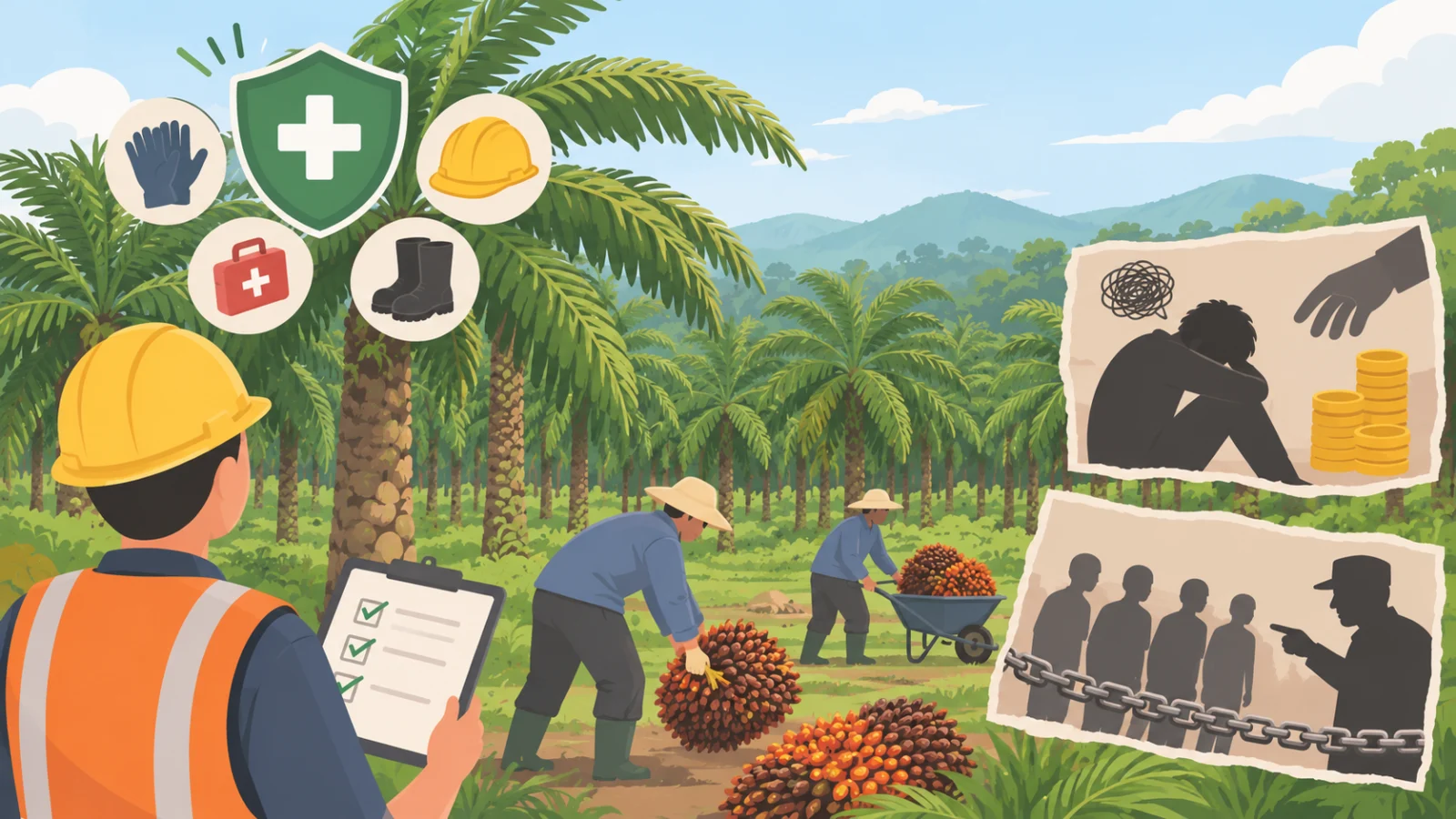
In oil palm plantations, occupational safety and health (OSH) is often viewed as a cost that can be minimized: personal protective equipment (PPE), training, medical check-ups, equipment maintenance, and safety procedures are considered to add expenses or hinder production targets.
This perspective not only ignores legal obligations. When companies obtain labour and work results while workers bear hazards without adequate protection, OSH issues also become matters of power, risk distribution, and exploitation. This issue needs to be examined further when workers are recruited or brought in from outside West Kalimantan, for example from East Nusa Tenggara, Lombok, Java, or Nias, to work in plantations far from their families and social networks. Region of origin and worker migration do not in themselves prove exploitation or trafficking in persons (TIP).
However, distance, isolation, dependence on the company for employment or housing, and limited access to information or grievance mechanisms can increase vulnerability.
If that vulnerability is exploited through deception, debt bondage, threats, withholding of wages or documents, restriction of freedom, or coercion to work in hazardous conditions, then the neglect of OSH can be part of a broader pattern of exploitation. Therefore, the analysis must be firm regarding such possibilities, but remain legally meticulous: poor OSH alone does not automatically prove forced labour, slavery, or trafficking in persons. Such allegations must be assessed based on the sequence of acts, means used, purpose or consequence of exploitation, and evidence examined by authorised officials.
Download the full article through the following link >> This Link <<