
0 views
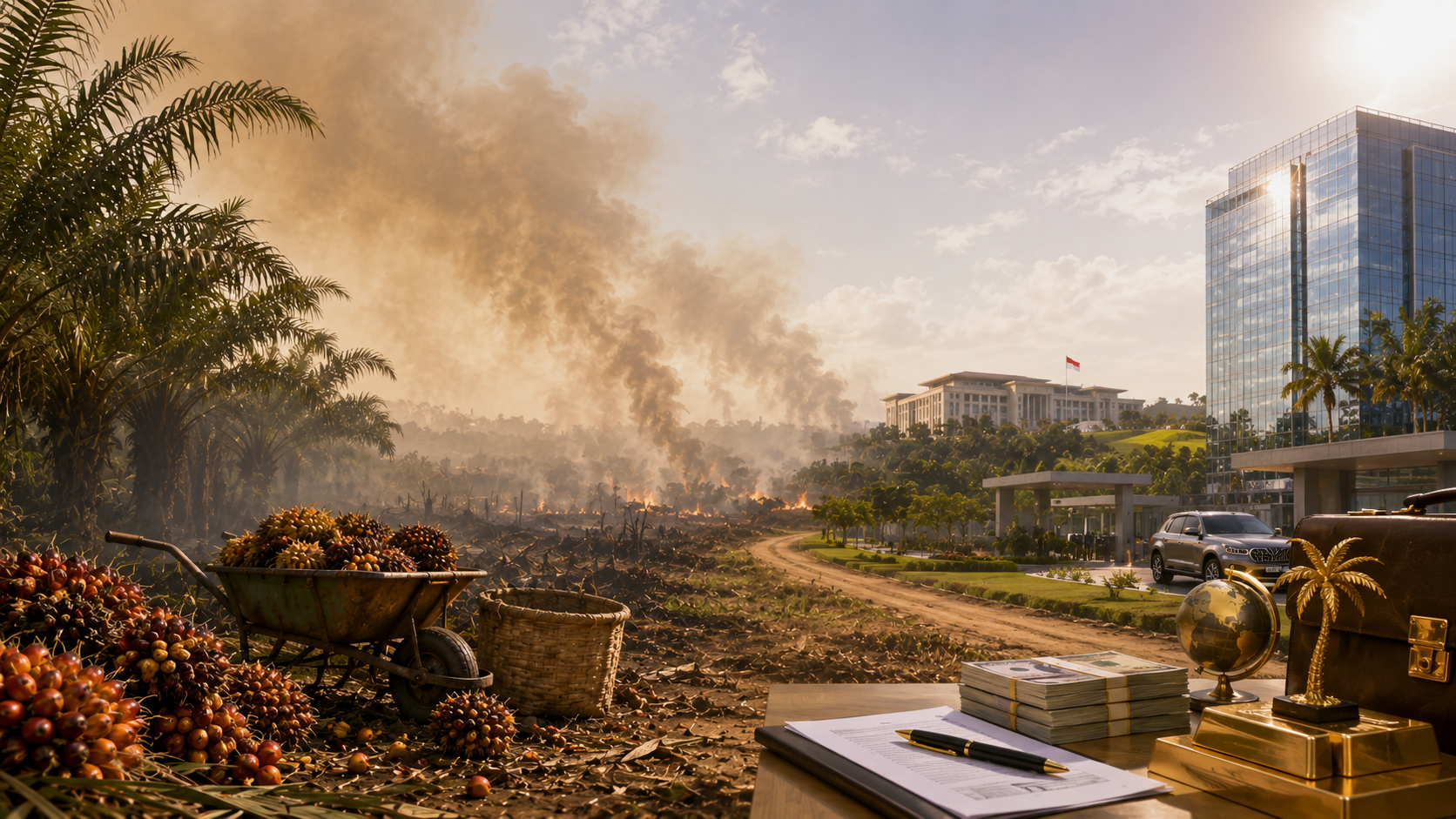
Hooray! For a whole month now, our beloved West Kalimantan has become a kind of free “haze resort”. This thin but suffocating blanket is a special gift from those among us who want to get rich quickly. Apparently, the road to wealth requires burning forests, land and perhaps a little of the public’s lungs.
We watch this forest-and-land-fire drama every year, with exactly the same plot: the dry season arrives, hotspots spring up like mushrooms after rain, and everyone scrambles to become an “emergency hero” with whatever mask they can find. But who is actually pulling the strings behind this production of “The Burning Forest”?
The Smoke Stage and Its Cast
Let us look at the raw data. We need few assumptions about haze when the facts are already there. WALHI’s 2026 data show just how “diligently” we turn forest to ash. Its analysis found that 74% of hotspots across Kalimantan lay within corporate concessions.
| Concession type | Hotspots in Kalimantan | Our “relaxed” commentary |
|---|---|---|
| Oil-palm plantations (HGU) | 10,739 | “Burn the land? Practical and cheap. Ash is good for the soil!” Says who? Someone who has not read an environmental-economics book. |
| Mining (bauxite and others) | 7,880 | “We’re going to dig it up anyway. Burn it first so it’s nice and clean.” |
| Industrial timber plantations and forest utilisation (PBPH) | 6,905 | “If forests make money, smoke is just a cost.” |
Total: 25,524 hotspots. In other words, roughly 74% of Kalimantan’s hotspots were inside corporate concessions.
We know “who” and “where”, but why do they do it? Not through stupidity, but through “clever”, “tempting” business calculations. When fire burns, companies save operating costs: no fertiliser to buy because ash is free; no tree-felling wages because fire is cheap; and no pesticides because pests burn too.
Worse still, in 2026 West Kalimantan became one of the country’s forest-and-land-fire epicentres, with 17,236 hotspots and 28,680 hectares burned.
The Audience Becomes the Victim: Soaring Respiratory Infections
While the actors on the concession stage play with fire, the audience—the public—pays dearly in health. Health Ministry data show an alarming surge in acute respiratory infections (ISPA). By 7 August 2026, West Kalimantan’s figures were enough to take our breath away, not just from smoke but from dismay. Ministry data record 151,956 cases between January and August 2026.
| Regency/City | ISPA cases | Reporting period | Source |
|---|---|---|---|
| Pontianak | 36,925 | January–mid-August | West Kalimantan Health Agency |
| Ketapang | 17,842 | January–mid-August | West Kalimantan Health Agency |
| Kubu Raya | 16,766 | January–mid-August | West Kalimantan Health Agency |
| Kayong Utara | 1,335 | January–mid-August | Kayong Utara Health Agency |
| Bengkayang | Rising trend | January–mid-August | Bengkayang Health Agency |
| Sambas | Rising trend | January–mid-August | Sambas Health Agency |
| Landak | Rising trend | January–mid-August | Landak Health Agency |
| Sanggau | Rising trend | January–mid-August | Sanggau Health Agency |
| Sekadau | Rising trend | January–mid-August | Sekadau Health Agency |
| Kapuas Hulu | Rising trend | January–mid-August | Kapuas Hulu Health Agency |
| Sintang | Rising trend | January–mid-August | Sintang Health Agency |
| Singkawang | Rising trend | January–mid-August | Singkawang Health Agency |
Imagine 151,000 people struggling to breathe while investors smile at rising share prices. The upward trend indicates the scale of the burden borne by communities. Meanwhile, regional health services remain limited in facilities and staff. Recorded figures may therefore fail to capture all actual cases, as attention and resources are absorbed by treating people affected by haze.
What about Oil-Palm Plantation Workers?
“We’re Just Paid Workers!” versus “We’re Trapped!”
Rather than talking endlessly about management, let us talk about workers: important actors in this performance too.
The “Creative”—and Unfortunate—Worker
In Berau, East Kalimantan, police arrested a worker identified as BS. His assignment? Clearing land for oil palm by burning it. “They said it fertilised the soil, Boss!” BS said innocently. The result: 12 hectares burned, including another company’s concession, with losses reaching Rp1.2 billion. BS now faces 12 years in prison.
Funny, isn’t it? We order workers to do the dirty work, but when the fire spreads and trouble comes, they are the first to be blamed.
Workers Who Were Literally Trapped
In Palangka Raya, 12 plantation workers guarding an estate were surrounded by fire and smoke, unable to leave. They survived, but their fear illustrates how companies often neglect worker safety to maximise production.
Dismissing Union Officials: A “Gift” for Hard Work
In West Kalimantan, two plantation-union officials—Yublina Yuliana Oematan, with 20 years’ service, and Irjan Bahrudin Dode—were dismissed by a Gunnas Group subsidiary. Their offence? Fighting for statutory rights, including personal protective equipment (APD), BPJS health and employment insurance, and the employment status of casual daily workers (BHL) with more than five years’ service.
These labour problems show how vulnerable groups remain trapped in exploitation: nature is exploited, and people with it. Yet other consequences often remain unseen: those affecting women workers, workers’ wives and their children.
Women Workers and Workers’ Wives: Multiple Burdens
Women on oil-palm plantations face greater health threats. Prolonged smoke exposure and hazardous chemicals—agrochemicals and pesticides—make them more vulnerable to miscarriage, premature birth, chemically induced reproductive dysfunction and more serious acute respiratory problems in the future.
Workers’ wives, who also work for plantation companies, face overlapping burdens during fires: caring for sick children, husbands and parents, with access to clean water and food increasingly constrained as natural resources burn, while poor air quality disrupts household work.
Solidaritas Perempuan notes that Indigenous and local women and workers’ wives are often treated unequally in climate-crisis mitigation. Government responses amount to “washing their hands” of responsibility and leaving women to cope alone.
Children are also among the most vulnerable because their respiratory systems are still developing. As noted above, children account for 70% of those affected by ISPA.
- Recurring infections: a mother in Pontianak described her daughter recovering after three weeks of fever, cough and a cold, only to fall ill again after going outside. What happens to workers’ children living in camps besieged by smoke?
- Impaired growth and development: frequent infections can affect children’s development. So much for the impact of the free nutritious meals programme (MBG)?
- Disrupted education: teaching stops, while learning facilities at home are limited and homes are surrounded by dust. Children study at home, yet smoke penetrates workers’ camps too. Company management makes no effort to ensure they can keep learning without smoke invading their homes.
Behind the dreadful statistics are more painful stories: women workers, workers’ wives and children live closest to the damage yet often furthest from protection and attention.
A paediatrician at YOS Soedarso Hospital in Pontianak explains that pollution and respiratory infections are closely linked. Poor air quality disturbs the balance of microorganisms in airways, increasing children’s susceptibility. Plantation workers’ children repeatedly face pollution and lung-health threats from dust on fruit-haulage roads. Every year, haze is something they get to “enjoy”.
| Group | Short-term impacts | Long-term impacts |
|---|---|---|
| Workers generally | ISPA, eye irritation, extreme fatigue | Impaired lung function, cardiovascular disease and greater cancer risk from pollutants and agrochemicals |
| Women workers | Miscarriage, premature birth, reproductive disorders | Permanent reproductive impairment; increased breast and reproductive-organ cancer risk |
| Workers’ wives | Overlapping exhaustion from care and housework; disrupted food and water access | Long-term psychological burdens and illness from smoke exposure while caring for families |
| Children | Recurring ISPA, fever and prolonged coughs and colds | Impaired growth and development, reduced lung function, difficulty concentrating on learning |
Ironically, there is still no regulation or policy specifically protecting plantation workers and their families or fulfilling their rights against the effects of forest and land fires. Government therefore continues to neglect basic rights, particularly their right to health.
Bosses and Oligarchs: “Thanks for the Smoke—Our Shares Are Up!”
This is the most absurd part of our drama. As fires hit West Kalimantan and the public suffers, plantation-company shares surge. It is like someone’s house burning down while their neighbour starts selling cooking oil.
Perhaps this should not surprise us: a minister in the current administration said that some people ask, “When will the crisis come?” A crisis brings them profits because commodity prices rise. Such a statement defies common sense.
| Stock | Increase | Market “logic” |
|---|---|---|
| JARR | +24.79% | “So much land burning—CPO will rise! Buy!” |
| BWPT | +18.48% | “Thicker smoke, thicker profits.” |
| ANJT | +5.35% | “Production may fall, but commodity prices will surely rise.” |
| TAPG | +5.19% | “Disaster? Opportunity.” |
| AALI | +2.26% | “If other companies burn, we profit!” |
These gains coincided with crude palm oil prices reaching their highest level since December 2024. Fire thus becomes an “investment” for speculators and oligarchs. CPO prices rise because of B50 biofuel demand and production concerns linked to El Niño. Ironically, El Niño and fires become a blessing for investors. This raises more serious questions: is there an intentional element to these fires? With technology enabling companies to track climate change and anticipate markets, learning from Europe’s extreme heatwaves, might some parties be exploiting the situation for profit?
Officials and Government: “Applause! State Coffers Fill, Workers Suffer!”
Amid all this, officials applaud. Why? Palm-oil production contributes handsomely to state revenues. In 2026, potential state income from administrative fines alone in palm oil and mining reaches Rp142.23 trillion: Rp109.6 trillion from palm oil and Rp32.63 trillion from mining. The country also risks losses of Rp1,428–1,820 trillion from palm oil if policies are misguided.
As workers keep producing, export earnings keep flowing. But what do workers receive?
- Exhaustion from working through smoke.
- Threats of dismissal if they speak out.
- Criminalisation if they become scapegoats.
- Sweet election promises, soon forgotten.
During COVID-19, palm-oil workers kept producing. During floods, they kept producing. When smoke surrounded concessions, they kept producing. Yet when they demanded their rights, their “reward” was dismissal and intimidation.
The political movement “Sawit Ikut Jokowi” (SawitIJO) once targeted 16 million workers’ votes and 2.2 million oil-palm farmers to win a presidential election. Workers are courted at election time and promised “beautiful flowers” to accompany them as they harvest, fertilise and transport fresh fruit bunches (TBS). But the promises are like smoke: they surround you briefly, then vanish.
Epilogue: Who Cares?
If anyone says palm-oil workers are heroes of foreign-exchange earnings, I agree. But what kind of hero is left working in smoke, threatened with dismissal for joining a union and criminalised for following orders?
Government is so busy counting more than Rp200 trillion for the state budget (APBN) and applauding that it forgets these workers are people, not machines. They have children needing school fees, families needing healthcare and lungs needing oxygen, not smoke.
Hooray for a month of haze over West Kalimantan? Hooray too for bosses whose shares rise, and officials whose state coffers fill. But for workers? Hooray… they are still breathing, though barely.