
0 views
A Case Study of Food Sovereignty in West Kalimantan amid Deforestation and Import Dependency
Download the article: Read the article
West Kalimantan faces a complex food paradox. On one hand, it has substantial horticultural production: 9,741 tonnes of cucumbers, 9,467 tonnes of bird’s-eye chillies and 144,892 tonnes of bananas in 2024. On the other, it still depends on vegetables brought in from Java and China.
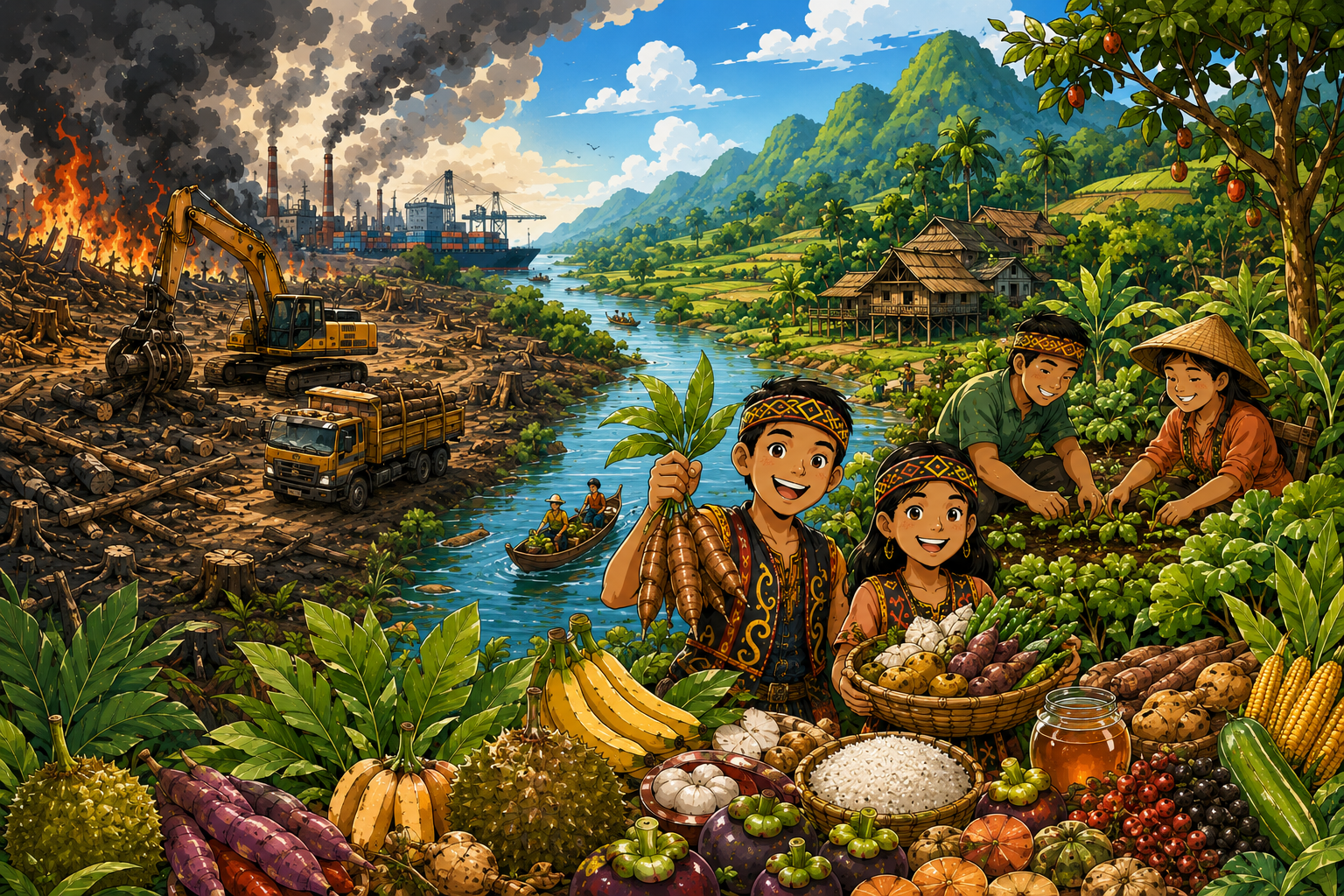
More troublingly, local foods such as tengkawang, wild cempedak, sour aubergine, wild mustard greens, sago, pekawai and taro are threatened with disappearance through deforestation. Limited government attention to developing local food resources further undermines food security. This article examines current conditions, draws lessons from successful countries and proposes a policy framework for a transition towards sustainable food sovereignty.
Production and Dependency: The Reality
Statistics Indonesia (BPS) data for West Kalimantan in 2024 show significant horticultural production. Cucumber output reached 9,741.46 tonnes, up 7.72%; bird’s-eye chillies 9,467.99 tonnes, up 14.37%; aubergines 6,955.78 tonnes, up 21.21%; and yardlong beans 6,955.78 tonnes, up 4.70%. Farmers also produced substantial quantities of fruit: 144,892.26 tonnes of bananas, 113,705.38 tonnes of oranges and 98,595.97 tonnes of pineapples.
Production centres are spread across Sintang, Mempawah, Sambas, Landak, Sanggau, Pontianak City, Singkawang City and Kubu Raya, each contributing significantly to different commodities.
Despite strong local production of certain crops, West Kalimantan still brings in vegetables from Java that are not yet grown optimally within the province, including carrots, potatoes, cabbage, broccoli and garlic. Some chillies and legumes also come from Java. Certain products are imported in substantial volumes from China: 1,200–1,500 tonnes of garlic a year, 800–1,000 tonnes of apples, 600–800 tonnes of mandarin oranges, and 400–600 tonnes of potatoes and carrots.
The “Invisible” Wealth of Local Food
The strength of local production is evident in BPS West Kalimantan’s 2024 horticultural data. Farmers produce fruit as well as vegetables. Unfortunately, this food biodiversity is poorly recorded in official statistics. Behind the figures lies an extraordinary range of local foods with market value locally, nationally and internationally. Forest fruits include wild cempedak, nau fruit, sour aubergine, mata kucing (Dimocarpus longan var. malesianus), wild durian, wild rambutan, wild longan, gandaria, duku, rambai and tampoi. With one of Indonesia’s longest river systems, hundreds of tributaries and peat-swamp forests, the province also has abundant freshwater protein sources, including baung, patin, lais, belida and jelawat fish, alongside other non-timber forest products.
Marine fish are plentiful too, given the coastal areas of Sambas, Bengkayang, Kubu Raya, Ketapang and Kayong Utara regencies and Singkawang City. In other words, West Kalimantan has a complete range of food resources from the land, rivers and sea.
The Threats of Deforestation and Climate Change
The conversion of forests, peat-swamp forests and river–marine ecosystems has caused extensive losses of local food sources. These losses are estimated at 40% over the past 30 years and correlate with a 20–30% decline in farming and rural household incomes. Communities that once obtained food without buying it must now pay, increasing household food costs by around 15–25%.
Climate change makes matters worse. Unpredictable rainfall and rising temperatures disrupt agricultural production. Crop failures among local fruit species have increased by 30–40%, particularly durian and several other fruits. Harvest seasons consequently become uncertain, disrupting traditional marketing systems.
Market and Economic Opportunities
Sharing a direct border with Malaysia gives West Kalimantan considerable opportunities to develop horticulture and forest products for international markets. Malaysian demand for vegetables is high, cited at around 40–60%, while domestic production is very limited. Malaysia must therefore import: around 58% of vegetables come from China, followed by Vietnam, Thailand, India and Pakistan.
Cucumbers, chillies, mustard greens, water spinach, okra and petai are popular and widely eaten in Malaysia. Demand continues to grow, particularly among urban consumers seeking organic, high-quality vegetables. This presents a major opportunity for West Kalimantan’s farmers. Fern shoots, bamboo shoots, young rattan, peanuts, soybeans and timun melela cucumbers are also popular.
Malaysian consumers also enjoy river fish such as baung, patin, lais, toman and snakehead. Fresh snakehead sells for around RM35.00 per kilogram. Assuming RM1 = Rp4,000, the stated price of snakehead, or haruan, is around Rp92,000 per kilogram.
Lessons from Countries That Have Successfully Promoted Horticulture
Increasing vegetable production and controlling deforestation, with serious government attention from policy through implementation, would raise regional and national revenues, strengthen farming livelihoods and ultimately improve public welfare. Yet agriculture and fisheries have not received sustained attention from either government or other civil-society actors. Literature and successful examples of land- and river-based food production offer lessons for practice.
Thailand, for example, has pursued product standardisation and certification, support for technology and design, government-facilitated access to markets through retailer partnerships, and stronger entrepreneurial skills among farmers. Between 2000 and 2010, this helped develop 8,651 local products. By 2019, local-product exports were worth US$1.2 billion, involving 1.5 million households and creating 300,000 jobs.
Peru developed a local superfood programme built around scientific research, protection of natural assets through geographical indications, stronger farmer cooperatives, and vigorous promotion by government and civil society. Exports rose to US$124 million in 2020. Some 70,000 farming families benefited as the selling value of local agricultural products increased by up to 500% in 10 years, or approximately 50% a year. There is much more to learn from approaches elsewhere, including Africa and Vietnam.
A Policy Framework for Food Sovereignty in West Kalimantan
Food is often treated as solely the central government’s responsibility, with its programmes, campaigns, networks and capital. Local governments consequently see their role as limited to ensuring food availability and safe stocks. In fact, they need the confidence to innovate and take the initiative, supported by data and concrete action.
Provincial, regency and city governments in West Kalimantan should begin designing and implementing participatory mapping and identification of local food resources from forests, waters and fruit species. A digital local-food database should be developed and incorporated into planning from village to provincial level. Governments should also recognise community food forests through existing regulatory schemes and provide conservation incentives, such as Payments for Ecosystem Services (PES). Protection, development support and capital should not be reserved for extractive companies. Certification of local varieties and geographical indications should also be made easier.
Economically, governments should offer dedicated local-food microcredit with non-conventional collateral, establish value-adding processing centres in each regency and create an integrated marketing platform. Food cooperatives should be formed, or existing cooperatives strengthened, to support this work. They could provide local seeds through seed banks, appropriate agricultural technologies, organic-standard assurance and digital documentation, all managed with communities.
Cooperatives also have a role in building networks and partnerships and opening access to traditional markets, modern retailers and export–import distributors. Malaysia’s demand for vegetables and fish offers West Kalimantan opportunities to add value and improve farming incomes beyond palm oil, rubber, coffee and cocoa. Amid climate change, government can develop a locally grounded economy built on a healthy environment.
Indonesian experts have offered both warnings and solutions. Prof. Dr Muhammad Maksum, Professor of Agricultural Economics at UNPAD, states that Indonesia has 77 local food-crop species resilient to climate change, yet only 15% are developed optimally—an immense neglected opportunity. West Kalimantan has diverse climate-resilient grains and rice varieties, as well as forest vegetables. Disturbingly, the total economic value of forests’ food services in Kalimantan, reaching US$15 million per regency per year, is absent from official economic accounting, according to Dr Yetti Rochwulaningsih, a political ecology researcher at UNDIP.
Conclusion
West Kalimantan produces certain commodities abundantly but still depends on imports for basic needs. This is compounded by local food wealth that remains undocumented: economically valuable, yet missing from statistical systems. Legal deforestation, which contributes to climate change, is a systemic threat to farmers. Government and communities can learn from and apply the experience of countries that have shown how local foods can drive economic development. A transformation is therefore needed, shifting the paradigm from preservation towards sustainable development—from today’s generation to the next.
Closing
Food sovereignty in West Kalimantan will not be achieved by continually importing from other islands or countries. It requires developing the wealth already rooted in its own soil. Tengkawang, wild cempedak, durian, sour aubergine, snakehead, baung and other local foods are more than a legacy of the past. They are assets for the sustainable prosperity of future generations.
This transformation requires political courage, active community participation and long-term commitment. Yet, as Thailand, Peru and Ethiopia have demonstrated, investing in local food is investing in national resilience, sovereignty and prosperity.
References
Badan Pusat Statistik Provinsi Kalimantan Barat. (2025). Statistik pertanian tanaman sayur dan buah-buahan Provinsi Kalimantan Barat 2024 (Vol. 15).
Badan Pusat Statistik RI. (2024). Statistik perdagangan luar negeri Indonesia 2023.
Kementerian Pertanian Republik Indonesia. (2024). Statistik hortikultura nasional 2023.
Rochwulaningsih, Y. (2023). Ekologi politik pangan lokal Kalimantan. UNDIP Press.
Food and Agriculture Organization (FAO). (2023). Indigenous food systems and biodiversity.
World Bank. (2023). Forest for food security and nutrition.