
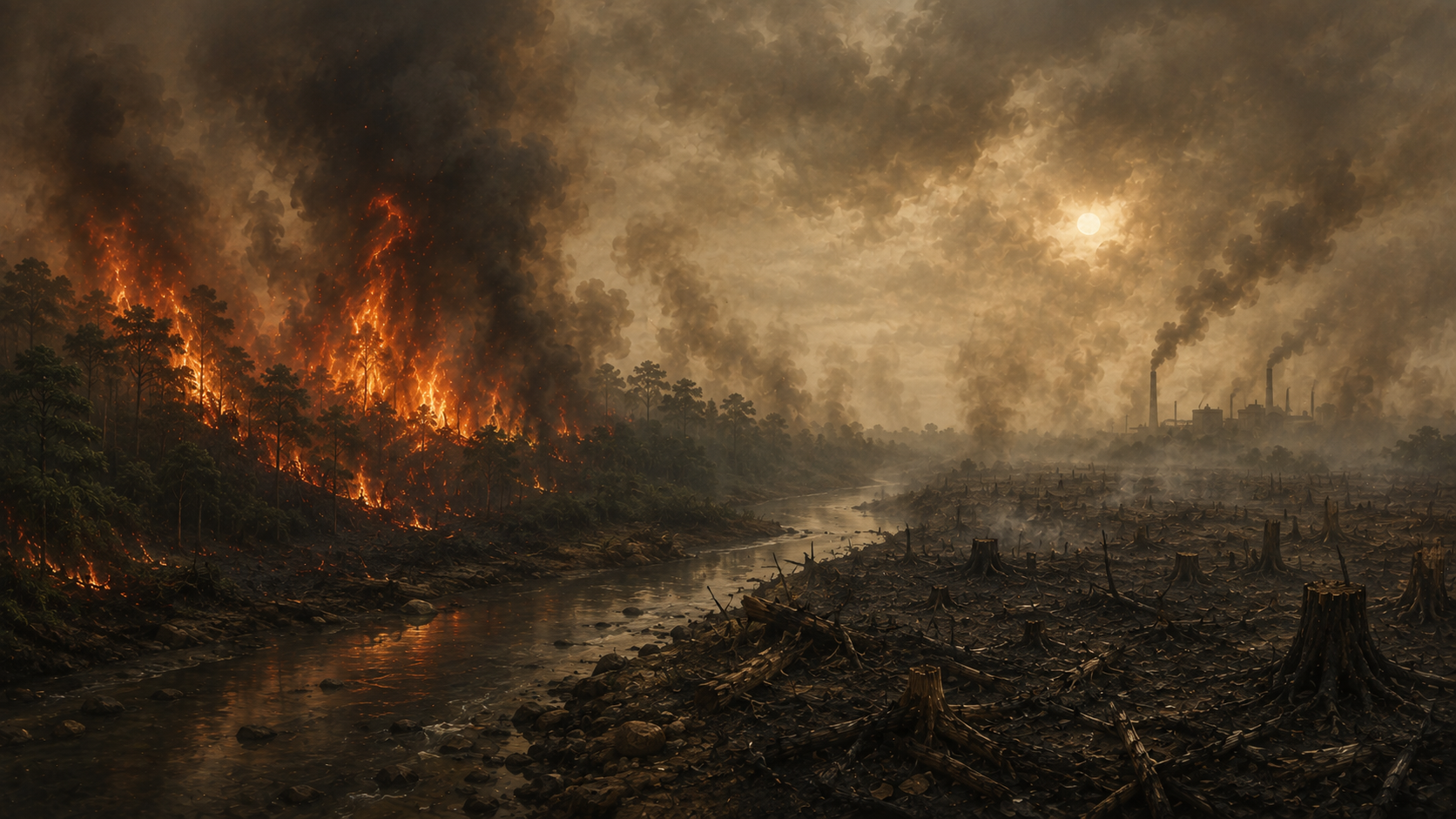
Making Sense of the Data: Who Is Really Starting the Fires?
Eight years of law-enforcement data (2018–2026) in West Kalimantan tell one story: asymmetry. On one side stand dozens of palm oil corporations whose concessions have repeatedly been sealed following fires: a company in Kubu Raya in 2018, 26 palm oil companies in 2019, 4 companies in 2023 and 6 companies in 2026. On the other stand traditional farmers who burn no more than two hectares to plant local rice varieties—a practice explicitly exempted by the elucidation of Article 69(1)(h) of Law No. 32 of 2009. Yet they are the ones most often handcuffed as “forest and land fire suspects”. The state, through the central government, even plans to repeal West Kalimantan Regional Regulation No. 1 of 2022 on Land Clearing for Cultivation Based on Local Wisdom. This perfectly reverses legal logic: protections for customary farmers are dismantled, while concessions where thousands of hectares burn receive only administrative sanctions. If the regulation is repealed, farmers will no longer be “cultivators practising local wisdom”, but prospective convicts. Companies responsible for fires, meanwhile, will remain “subjects of guidance”.
A Critical Analysis: Weak Enforcement and Signs of Manipulation
Three empirical patterns suggest that enforcement against forest and land fires is not weak through incapacity, but designed to fail:
1. Repeated Fires in the Same Places: Spatial Impunity
PT Sumatera Unggul Makmur was sealed in 2018 and experienced fires again in 2023. Kubu Raya and Ketapang become fire epicentres every year. In Becker’s deterrence theory, repeated violations occur when the expected penalty is far below the expected profit. A Rp1 billion fine for PT PSL—or merely administrative sanctions—is an “operating cost” for corporations, not a punishment.
2. Anonymisation and Delayed Enforcement
Official releases identify companies by initials, such as PT SUM and PT WEL: transparency deliberately blurred. Of nine final and binding civil judgments over forest and land fires, only one has been enforced. The Rp920 billion judgment against PT Rafi Kamajaya Abadi in 2023 is the exception that proves the rule: 157 companies were sanctioned in 2019, but only two were taken to court.
3. Unequal Application of Legal Provisions
Corporations benefit from administrative routes and strict liability that is rarely applied, while farmers face criminal provisions under environmental protection and management or plantation laws. In the language of Galanter’s critical legal studies, this confirms that “the haves come out ahead”: the law treats those with capital more leniently. Read through political ecology and regulatory-capture theory, these three patterns point to one conclusion: law-enforcement authorities are not neutral. There are strong indications that palm oil oligarchic interests are being protected: let fires burn, seal the concessions, impose light sanctions and await the next dry season. Residents endure what Rob Nixon calls slow violence: 165,000 cases of acute respiratory infection, a parched Kapuas River and children studying online behind their masks.
The President Must Declare a National Disaster
The criteria in Government Regulation No. 21 of 2008—casualties, losses, impacts across regions and disruption to livelihoods—have been met: 3.4 million people exposed across six provinces, hazardous air quality, schools moved online and a risk of transboundary haze. A national-disaster declaration is not merely symbolic. It compels the mobilisation of national resources, a unified command under the National Disaster Management Agency (BNPB) and, what the oligarchy fears most, a comprehensive concession audit.
The argument is therefore simple and uncompromising: if the President does not declare a national disaster, that reluctance itself becomes further evidence that the state is more occupied with protecting corporations than its citizens. Every day of delay is a hidden subsidy for those responsible for the fires.
DECLARE FOREST AND LAND FIRES A NATIONAL DISASTER!
Download the full article: Read the article